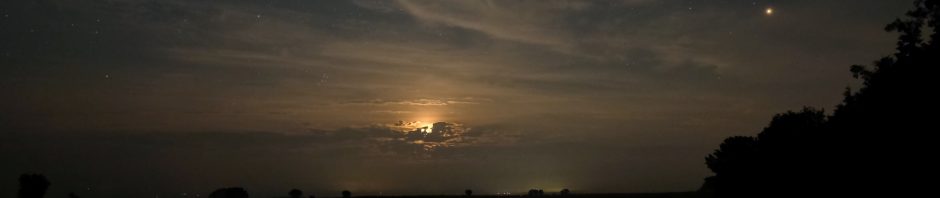
- You won’t see many stars mid-summer because the sky doesn’t get completely dark at the UK’s latitude. But we do get ghostly and beautiful Noctilucent Clouds. They are the highest clouds that can form in the Earth’s atmosphere, about 60 miles up. Comprising ice crystals and dust (some of it cosmic in origin) they take on an ethereal electric blue colour. Look for them due north an hour after sunset, or before sunrise. Expect them to show up anytime between May and late August.
- Early August sees the return of properly dark skies to the UK and is perfect for Milky Way viewing. This river of light is directly overhead late evening and can be seen on moonless nights. It is affected by light pollution so you will need to view from somewhere reasonably dark. It’s well placed right up until the end of the year. But what is it? In a sentence the edge on view of our own galaxy consisting of millions of faint stars.
- Everyone loves shooting stars and we have some marvellous displays to look forward to. The first of the major ones is the Perseids, which peak in intensity on 12-13 August. The moon is absent this year meaning we will see fainter meteors. As with all such showers the advice is to use your naked eye and look high in the south eastern sky. The later the better. Wrap up warm and relax on a deckchair. Don’t expect a sky full of “fireworks” but be patient. It really is worth it. For the record shooting stars are tiny bits of debris, typically left behind by a comet, burning up in the Earth’s atmosphere.
- The 12 August also sees another astro phenomenon – a solar eclipse. This is not a full eclipse so the evening won’t be plunged into darkness, but it is a significant one with about 90% of the sunlight blocked from the UK by the moon. Maximum eclipse occurs a little after 7pm, but by that time the sun will be pretty low in the west. So you are going to need a good low horizon in that direction. Even though a lot of sunlight is blocked, it still has the potential to permanently damaging your eyes if you look direct So don’t do it! The only safe way is by using good quality eclipse glasses, or a telescope equipped with proper blocking filters. Be careful.
- 26 September sees the most famous full moon of them all – the Harvest Moon. If big moons have names – such as Wolf or Beaver – they often originate from distant cultures such as North American native peoples and have been popularised elsewhere. But this one is of old European origins. It’s significance is because this is the time when the harvest is gathered. Before mechanisation and artificial light the full moon helped get the job done. It is also sometimes called the Corn or Barley Moon. Whatever, it’s a beautiful adornment to the season of mellow fruitfulness.
- Saturn reaches its closest point to the Earth in 2026 on 4 October. That’s all relative because it is still almost 800 million miles away. Visible most of the night, it looks like a reasonably bright yellow star in the south. The planet has appeared low in UK skies for quite a while now, but each year it is climbing higher. That’s good because the higher an object is above the horizon the sharper the view. What is more the famous rings are more visible this year than last, restoring the planet’s beauty. To see them you will need a telescope and a magnification approaching 40x. The planet remains well placed for the rest of the calendar year.
- October also sees another of the great meteor showers. These are the Orionids (21/22 October) and on this occasion we’ll also have a big moon to contend with. The shooting stars are caused by debris left behind by Halley’s Comet. The year has two more showers in store – the Leonids on 18 November (a modest affair these days) and the best of the lot, the Geminids on 13/14 December. These are very reliable and expect to see quite a few if you invest a bit of time. More good news is that the moon will be absent. At this point a should clarify something. The dates given above are the predicted peaks in shooting star activity. In reality many showers are visible in the days before and after this expected climax. So if it’s cloudy, it is still worth looking when clear nights do appear.
- If you are a keen follower of Supermoons – when our nearest neighbour looms a bit larger in the sky than average – then there are two more ahead of us on 24 November and 24 December. The later sees the moon come within 221,667 miles of us – which in these terms is actually a very close approach. It will make Christmas Eve even more magical.
- By the year’s end you are going to notice a couple of very bright “stars” in the south east sky. Both are actually planets. The brighter one is Jupiter – climbing ever higher into the sky and will look amazing through a telescope. The other one with a distinct reddish tinge is Mars. Both are building up to their closest approach to the Earth in Feb 2027.
What to look out for in 2026

This entry was posted in astronomy, outreach, science and tagged astro-tourism, astronomy, comet, dark skies, moon, planets, star party, stargazing, stars. Bookmark the permalink.
 Dark Skies UK
Nice picture of the noculuicent clouds,I saw loads from Seaton Carew beach in Co Durham last spring/summer think the most I’ve ever seen and the bonus of the comet ☄️ behind them!been hoping that due to the recent extremely cold weather that the second ,and rarer ,extremely high cloud type, nacrous clouds, might make there way south to northern England but no luck.
LikeLiked by 1 person